Every Animal Colour in Planet Zoo’s Conservation Pack
The Planet Zoo Conservation Pack brings five new animals to your zoo, each one endangered or even critically endangered.
You’ll find four new habitat animals in this pack: Przewalski’s horses, amur leopards, siamangs, and scimitar-horned oryxes.
There’s also a new exhibit animal, the axolotl, which comes with two rare colourmorphs.
This pack is full of fascinating animals, including the last wild horse species in the world and the rarest big cat!
There aren’t a lot of colourmorphs in this DLC, just 14 in total, and only three of them are rare. Only one habitat animal has a rare colourmorph.
Here’s a full list of all the animals and their colourmorphs you can discover in the Conservation Pack!
OVERVIEW
Total number of animals: 5
Habitat animals: Przewalski’s horse, amur leopard, siamang and scimitar-horned oryx
Exhibit animals: Axolotl
Total number of colour morphs: 14
Animals with special coats: Amur leopard and axolotl
Przewalski’s Horse
Przewalski’s horse is the last true wild horse species in the world!
These rare horses live in Mongolia, where they are critically endangered.
At one point, Przewalski’s horses actually became extinct in the wild, but thanks to breeding programs, they were reintroduced in the 1990s.
The entire wild population today comes from just 14 horses!
Przewalski’s horses in Planet Zoo come in three different shades of brown and have no special coats.
Total colour morphs: 3

Colours are listed as:
- Tan coat with dark primitive markings
- Beige coat with dark primitive markings
- Dun coat with dark primitive markings
Amur Leopard
There are fewer than 200 Amur leopards left in the wild, making them the rarest big cats on Earth!
Amur leopards live along the border between Russia and China. Their thick yellow fur keeps them warm through freezing winters, and in the coldest months, it can grow up to 7cm long.
Their spotted fur makes for perfect camouflage, helping them blend into the trees. Amur leopards are also paler than other leopards, with bigger and more spaced out rosettes, which helps them hide in the snow.
Just like we have unique fingerprints, each leopard also has its own unique pattern of spots!
In Planet Zoo, amur leopards have three slightly different shades of yellow, although the differences are so subtle that it’s hard to spot. There’s also a black melanistic colourmorph.
Total colour morphs: 4
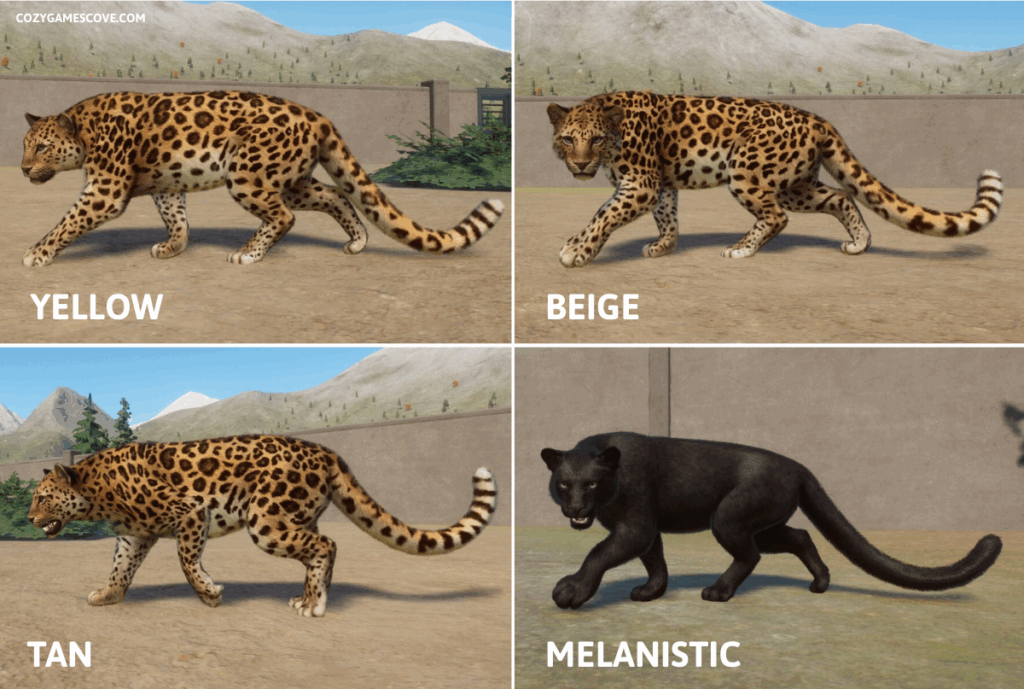
Colours are listed as:
- Thick yellow fur with black rosettes
- Thick beige fur with black rosettes
- Thick tan fur with black rosettes
- Melanistic: Thick black fur with faint black rosettes
Siamang
Siamangs are currently listed as endangered, with their population dropping by half in the last 40 years. This is mostly due to the illegal pet trade and the loss of their homes.
Even though siamangs are protected by law, adults are often killed so their babies can be taken and sold as pets.
Deforestation for palm oil plantations and timber is also one of the biggest threats facing siamangs today.
Siamangs are sometimes mistaken for monkeys, but they are actually a type of gibbon, a small ape found in the forests of Southeast Asia.
One of the most unique things about siamangs is their throat sac. They inflate it when they call to each other, and their loud vocalisations can travel for more than two miles through the forest.
In Planet Zoo, siamangs are only available in one colour, with black, shaggy fur.
Total colour morphs: 1
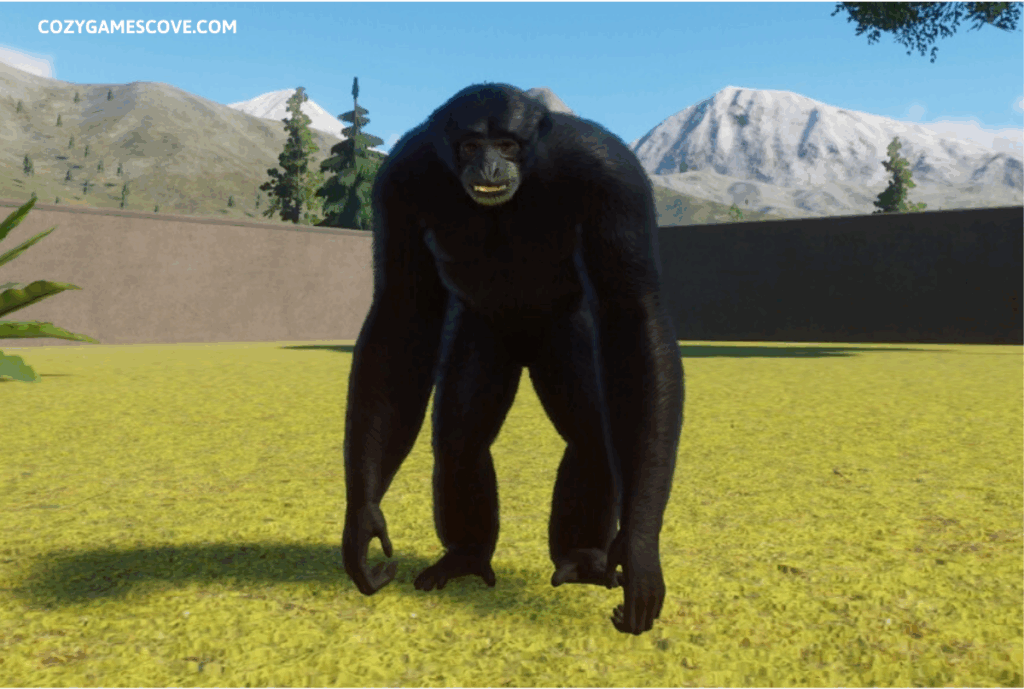
Colours are listed as:
- Black shaggy fur
Scimitar-Horned Oryx
Total colour morphs: 3
The scimitar-horned oryx once roamed across North Africa, but by 2000, it was declared extinct in the wild after being hunted for its horns and meat.
However, thanks to a successful conservation effort, scimitar oryx have now been reintroduced into protected areas, and their status has been downlisted to endangered.
Scimitar-horned oryx are amazingly well adapted to desert life, able to survive in temperatures that would be deadly for most other mammals.
Their white coats help reflect the sun’s rays and keep them cool, while their black skin underneath protects them from sunburn.
In Planet Zoo, the scimitar-horned oryx is available in three slightly different shades of white, although the differences are quite subtle.
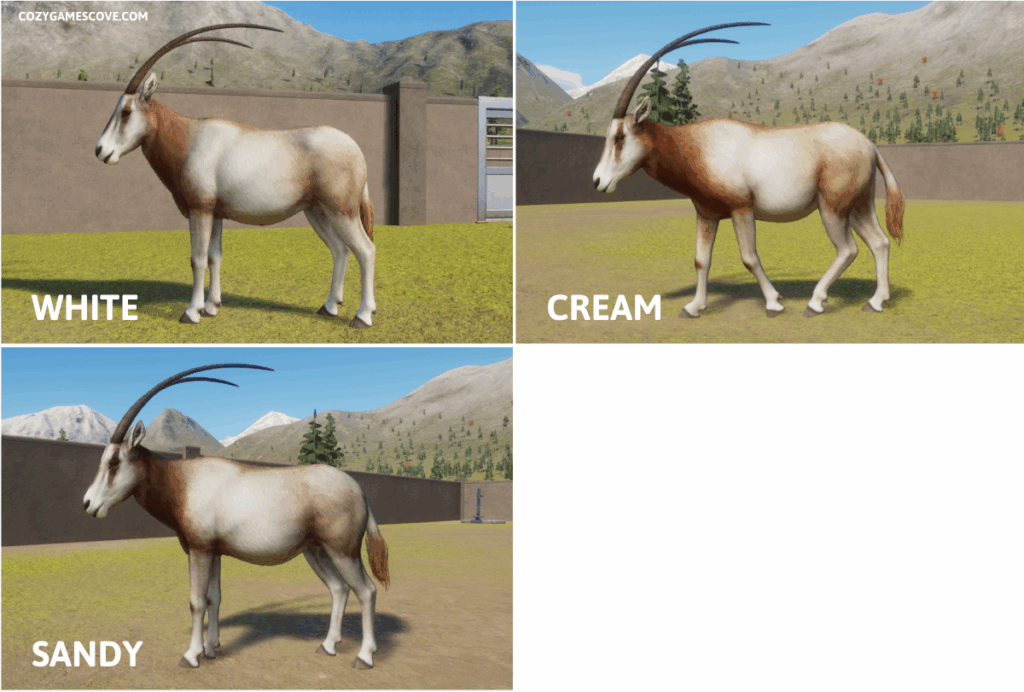
Colours are listed as:
- White coat with red neck and flanks
- Cream coat with red neck and flanks
- Sandy coat with red neck and flanks
Axolotl
Axolotls are now considered critically endangered, with fewer than 1,000 left in the wild, and some estimates suggest there may be as few as 50. At one point, scientists even thought they might disappear completely by 2020.
This dramatic decline is mostly due to water pollution, habitat loss, and the introduction of invasive species like perch and tilapia. These fish compete with axolotls for food and sometimes eat their young.
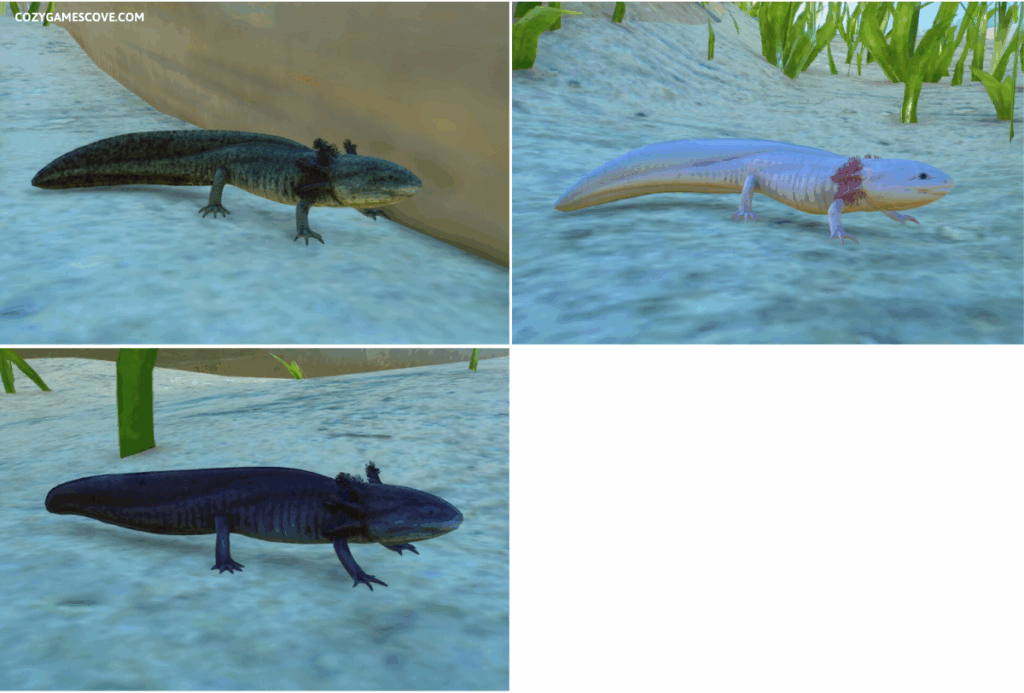
In Planet Zoo, the standard axolotl has the same mottled brown-grey coloring as wild axolotls. There are also two rare colours, the melanoid axolotl, which is black, and the leucistic axolotl, which is pink.
Total colour morphs: 3
Every Animal Colour in Planet Zoo
I’ve put together a list of every animal color from all the Planet Zoo packs!
Here’s a breakdown of the colours by pack: