Every Animal Colour in Planet Zoo’s Eurasia Pack
The Planet Zoo Eurasia DLC adds eight new species for you to welcome into your zoo, each one native to different parts of Europe and Asia.
You’ll find seven new habitat animals in this pack, including mute swans, saiga, sloth bears, takins, wisents, wild boars, and wolverines.
The Hermann’s tortoise is the new exhibit animal featured in this pack.
There are 18 colourmorphs to discover in total, three of which are rare colours.
Here’s a complete list of all the animals and their colourmorphs you can find in the Eurasia Pack!
OVERVIEW
Total number of animals: 8
Habitat animals: Mute swan, saiga, sloth bear, takin, wisent, wild boar and wolverine.
Exhibit animals: Hermann’s tortoise
Total number of colour morphs: 18
Animals with special coats: Mute swan, saiga and wolverine.
Mute Swan
Mute swans are among the heaviest birds that can fly, and you can find them across Europe and parts of Asia.
In England and Wales, the British Crown owns all unmarked mute swans found in open water. This royal tradition dates back to the 12th century.
In fact, some swans on the River Thames wear a leg ring displaying a silver crown, marking them as belonging to the monarch.
There is a leucistic mute swan in this pack, but since the colour difference only shows on its feet, it can be difficult to spot.
Total colour morphs: 2
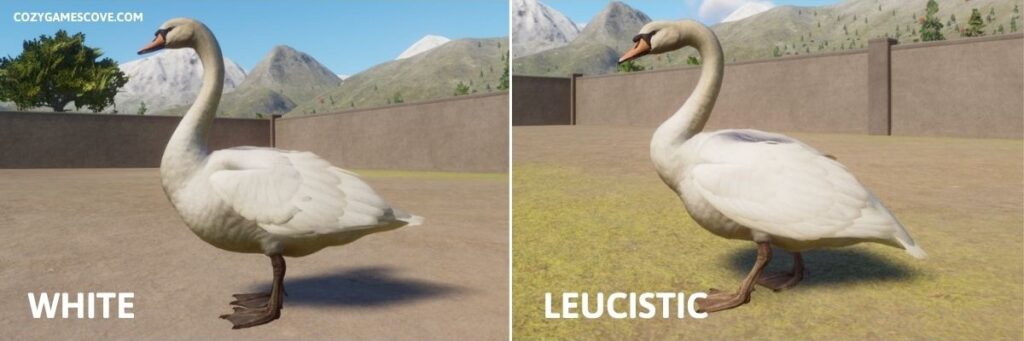
Colours are listed as:
- White feathers and black feet
- Leucistic: White feathers and pink feet
Saiga
These cute antelopes have been around since the ice age, surviving long after mammoths and sabre-toothed tigers disappeared.
These antelopes used to travel across the dry plains of eastern Europe and Asia. Today, they are listed as Critically Endangered on the IUCN Red List.
Their numbers dropped from around a million in the early 1990s to just six percent of that by 2005. Now, they are found only in smaller areas in Kazakhstan, Mongolia, Russia, Turkmenistan, and Uzbekistan.
In Planet Zoo, the saiga comes in three shades of golden brown and can also appear with rare albino white fur.
Total colour morphs: 4
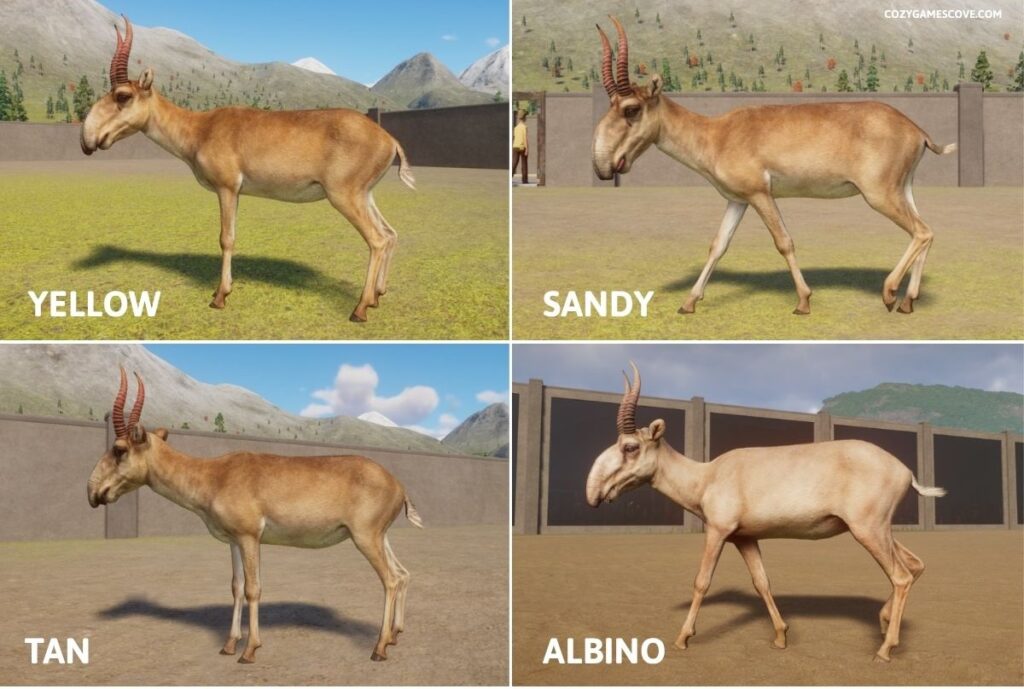
Colours are listed as:
- Yellow fur
- Sandy fur
- Tan fur
- Albino: White fur
Sloth Bear
This solitary bear lives in the forests of South Asia and eats termites, ants, and fruit. These bears are active at night and do not have front teeth, which helps them suck up termites easily.
Sloth bears are the only bears that regularly carry their cubs on their backs, usually for the first seven to nine months.
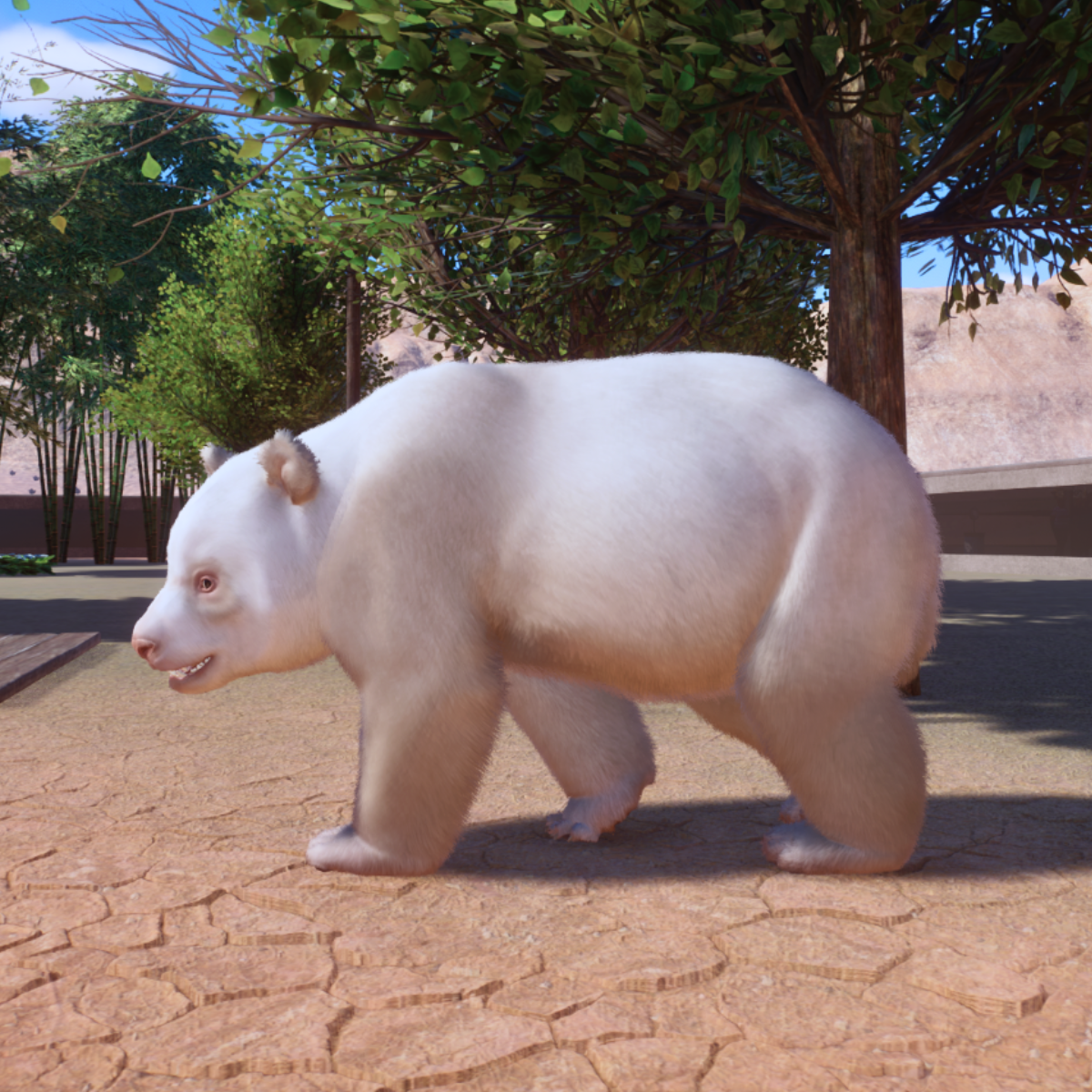
In Planet Zoo, the sloth bear comes in just one coat color, along with an albino variant.
Total colour morphs: 2
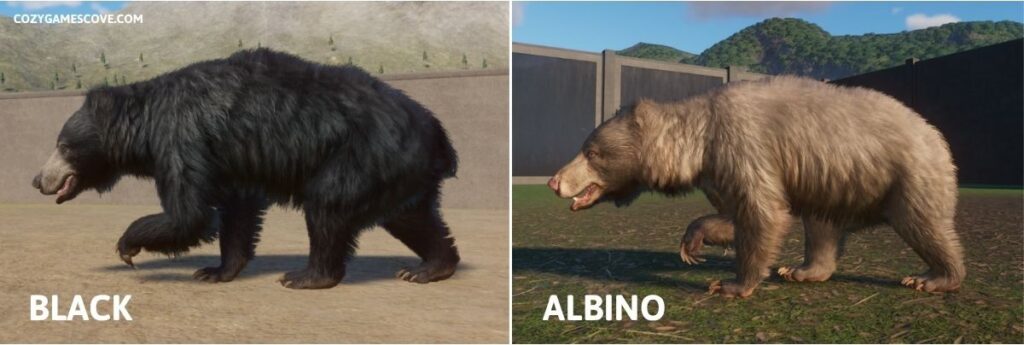
Colours are listed as:
- Thick, shaggy black fur with light chest markings
- Albino: Thick, shaggy tan fur and blue eyes
Takin
These large, hoofed mammals are native to the Eastern Himalayas and are the national animal of Bhutan.
They have a special place in Bhutanese culture and mythology. According to legend, the Tibetan saint Lam Drukpa Kunley created the animal by combining the head of a goat with the body of a cow.
They are also highly valued in China, where they receive the highest level of legal protection, just like giant pandas.
The takin has three golden colours in Planet Zoo, and no special coats.
Total colour morphs: 2
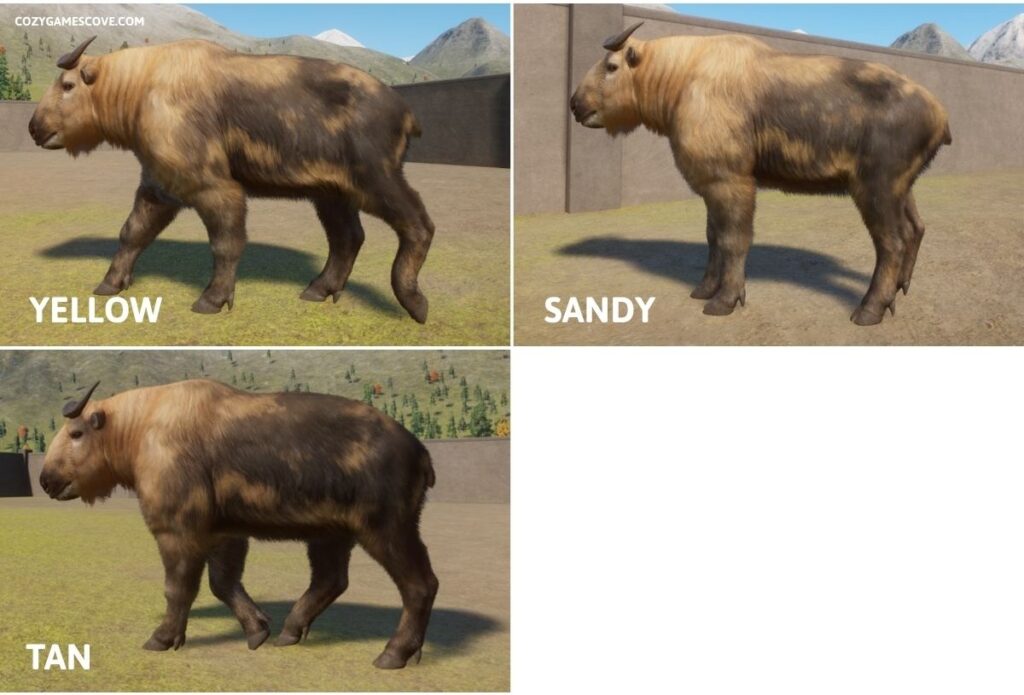
Colours are listed as:
- Thick sandy and black marbled fur
- Thick yellow and black marbled fur
- Thick tan and black marbled fur
Wisent
The wisent, also called the European bison, is actually a different species from the American bison, even though they look quite similar.
They are the heaviest land animal in Europe.
By 1920, wisent had become extinct in the wild, with only 54 left in captivity. In 1929, the first successful reintroduction from zoos happened in Poland, so all wisent alive today are descended from those few animals.
In Planet Zoo, you can find the wisent in three shades of brown, along with a rare leucistic white variant.
Total colour morphs: 4
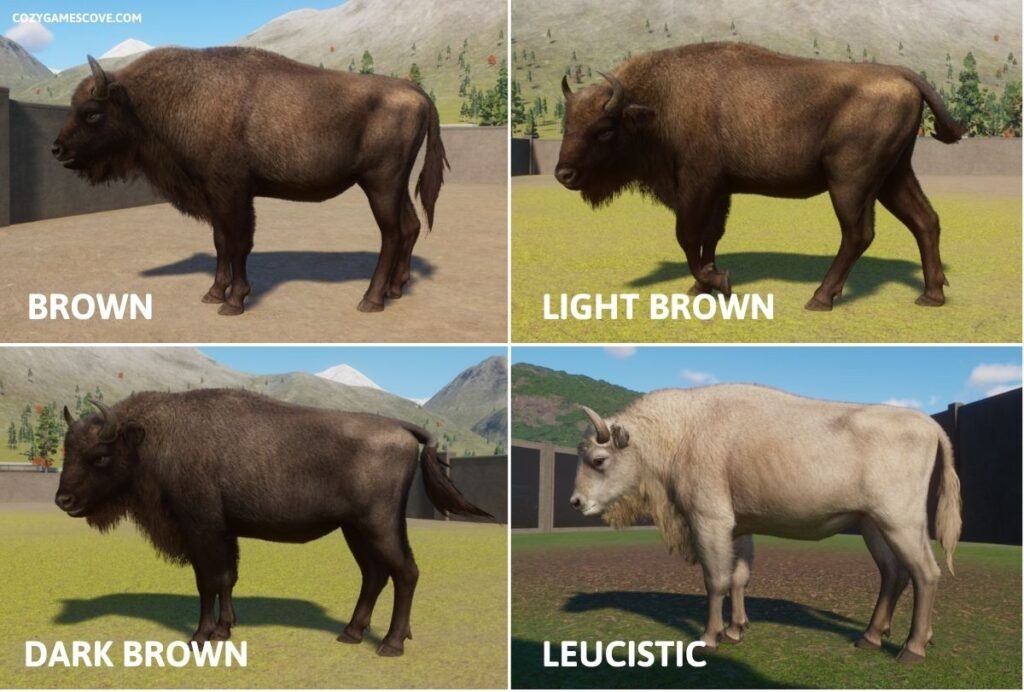
Colours are listed as:
- Brown fur and shaggy mane
- Light brown fur and shaggy mane
- Dark brown fur and shaggy mane
- Leucistic: White fur and shaggy mane
Wild Boar
Wild boar originated in Southeast Asia and later spread across mainland Eurasia.
Today, they are one of the most widespread mammals in the world and can be found on every continent except Antarctica.
Wild boars and domesticated pigs are actually the same species. Domesticated pigs are a subspecies of wild boar, and the two can interbreed.
Wild boars in Planet Zoo come in three shades of brown and have a white leucistic variant.
Total colour morphs: 4
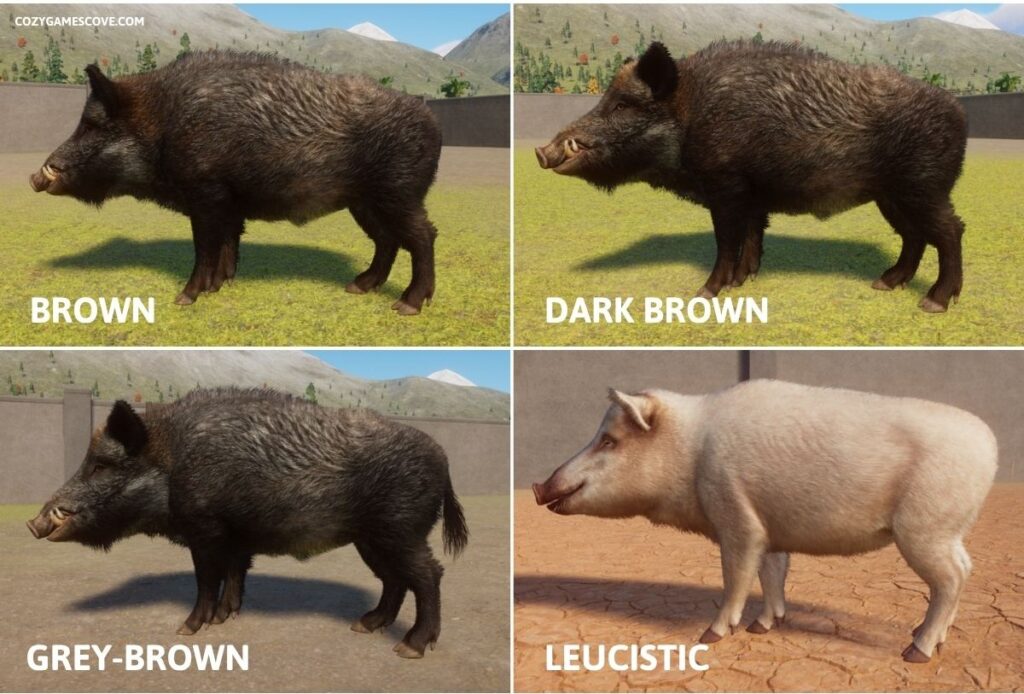
Colours are listed as:
- Brown shaggy bristles
- Dark brown shaggy bristles
- Grey-brown shaggy bristles
- Leucistic: White shaggy bristles
Wolverine
Wolverines are the largest land-dwelling members of the weasel family. They are sometimes called skunk bears because they release a strong odour from their scent glands when they feel threatened or scared.
One of the biggest threats to wolverines today is human activity. As people encroach on their remote environments, it becomes harder for wolverines to find safe, undisturbed places to live. Wolverines are also killed because they prey on domesticated animals such as reindeer.
Climate change is also a concern because they depend on deep snow for denning and raising their young.
In Planet Zoo, wolverines come in five colours. Three of them are brown with different colour body markings. There is also an albino wolverine and a leucistic one with grey markings.
Total colour morphs: 5
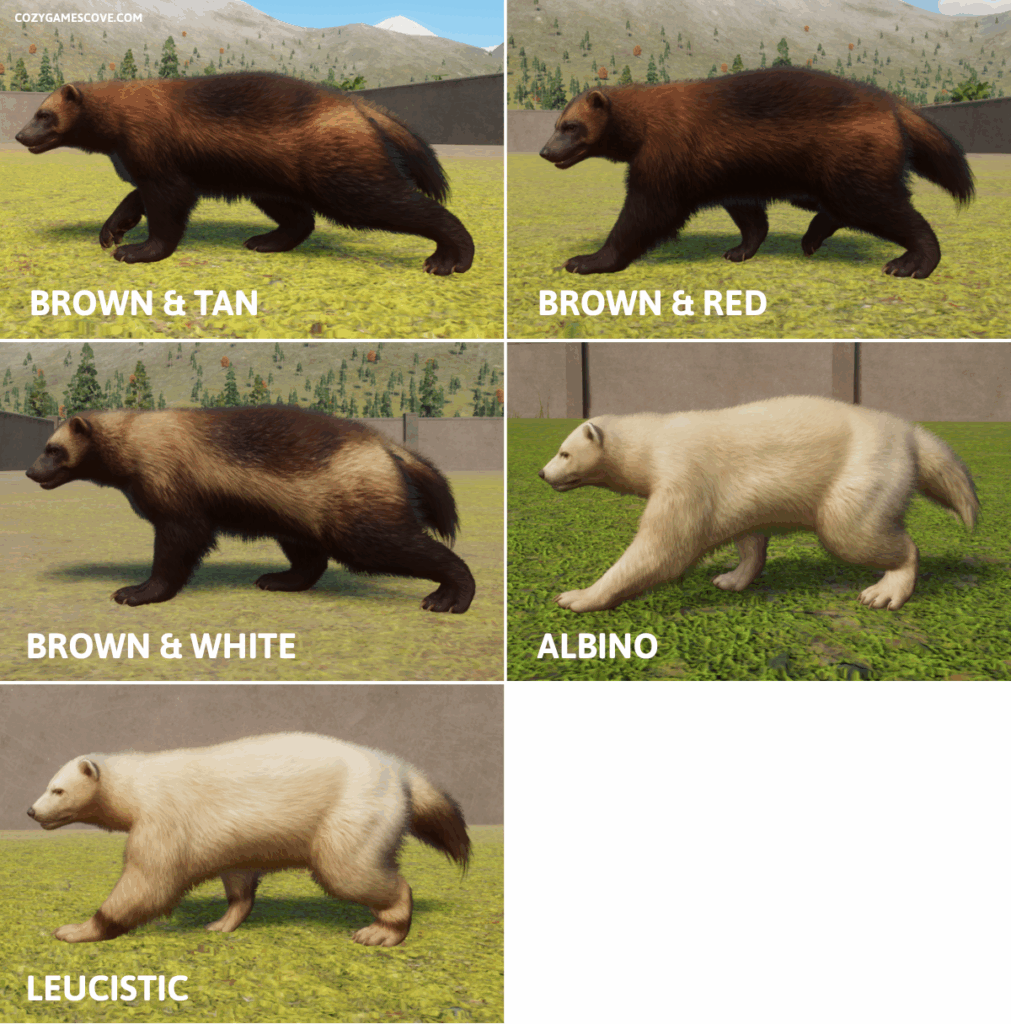
Colours are listed as:
- Brown fluffy fur with tan body markings
- Brown fluffy fur with red body markings
- Brown fluffy fur with white body markings
- Albino: White fluffy fur
- Leucistic: White fluffy fur with grey limb markings
Hermann’s Tortoise
Hermann’s tortoise is a small species of tortoise native to southern Europe.
They have a slightly hooked upper jaw and, like other tortoises, do not have any teeth.
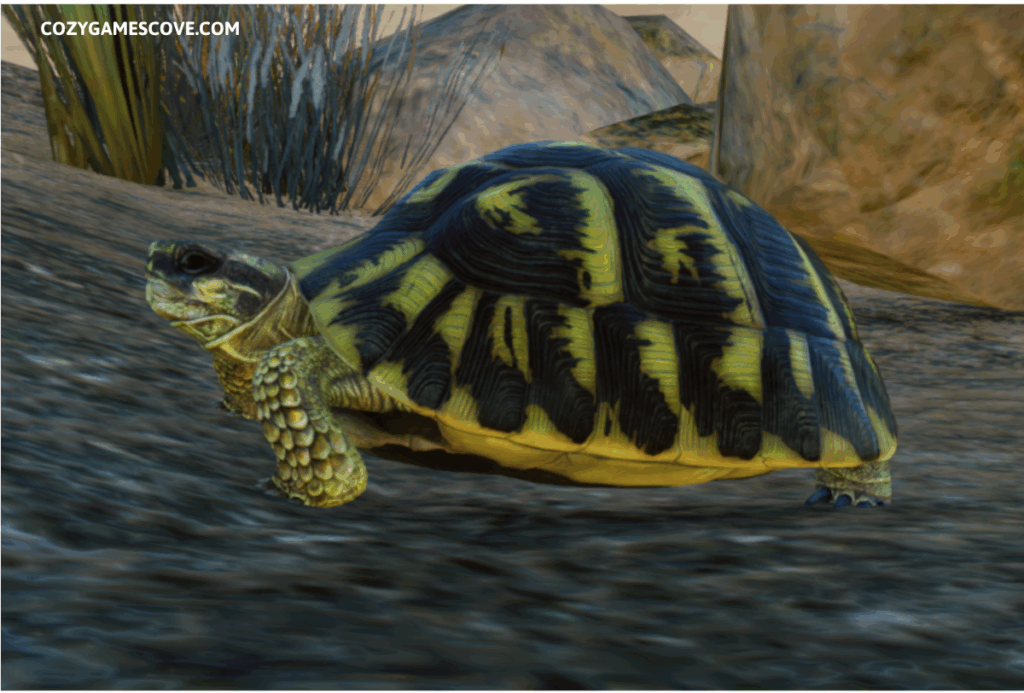
In Planet Zoo, exhibit animals are not labelled by colour, but Hermann’s tortoises have distinctive black and yellow shells.
A List of Every Animal Colour in Planet Zoo
I’ve completed a list of every single animal colour across all the Planet Zoo packs. The list is complete!
Here are all the colours by pack: