A Complete List of Animals & Colours in the Planet Zoo Arid Animal Pack
The Planet Zoo Arid Animal Pack adds eight unique animals to your zoo, each specially adapted to survive in hot, dry environments with very little rainfall.
This pack includes seven new habitat animals: dromedary camels, addaxs, dama gazelles, African crested porcupines, sand cats, black rhinoceros, and Somali wild asses.
There is also a new exhibit animal: the desert horned viper, a venomous snake.
This pack includes some fascinating animals, with several that are critically endangered. It also features the largest porcupine species and the largest gazelle.
You can discover 35 different colourmorphs in this pack, including 17 just for the dromedary camel, which is more than most animals in the game.
Below is a complete list of all the animals and their colourmorphs you can find in the Arid Pack.
OVERVIEW
Total number of animals: 8
Habitat animals: Dromedary camel, addax, dama gazelle, African crested porcupine, sand cat, black rhinoceros, and Somali wild ass
Exhibit animals: Desert horned viper
Total number of colour morphs: 35
Animals with special coats: Dromedary camel and African crested porcupine
Dromedary Camel
Dromedary camels are native to northern Africa and southwestern Asia. In the 1800s, they were brought to Australia, and now Australia has the world’s largest wild population of dromedary camels.
A dromedary camel’s hump can hold up to 80 pounds of fat, which the camel can turn into water and energy when food is scarce. These camels can travel up to 100 miles across the desert without water. When they do stop to drink, they can take in 30 gallons in only 13 minutes.
Dromedaries also have other clever adaptations for desert life. They can close their nostrils to keep out blowing sand, and their thick eyebrows and double rows of long eyelashes help shield their eyes from the sun and dust.
There are an impressive 17 dromedary camel colours in Planet Zoo. You can find six shades of brown, each with a matching piebald version. There are also three leucistic colours in various shades of white. On top of that, there’s a black melanistic camel and a special colour unique to dromedaries, the melanistic piebald.
Note: Some piebald colours don’t show up in the information panel, so the only way to spot them is by looking at the animal itself. For instance, a brown piebald camel is listed as “brown coat,” just like a regular brown camel.
Total colourmorphs: 17
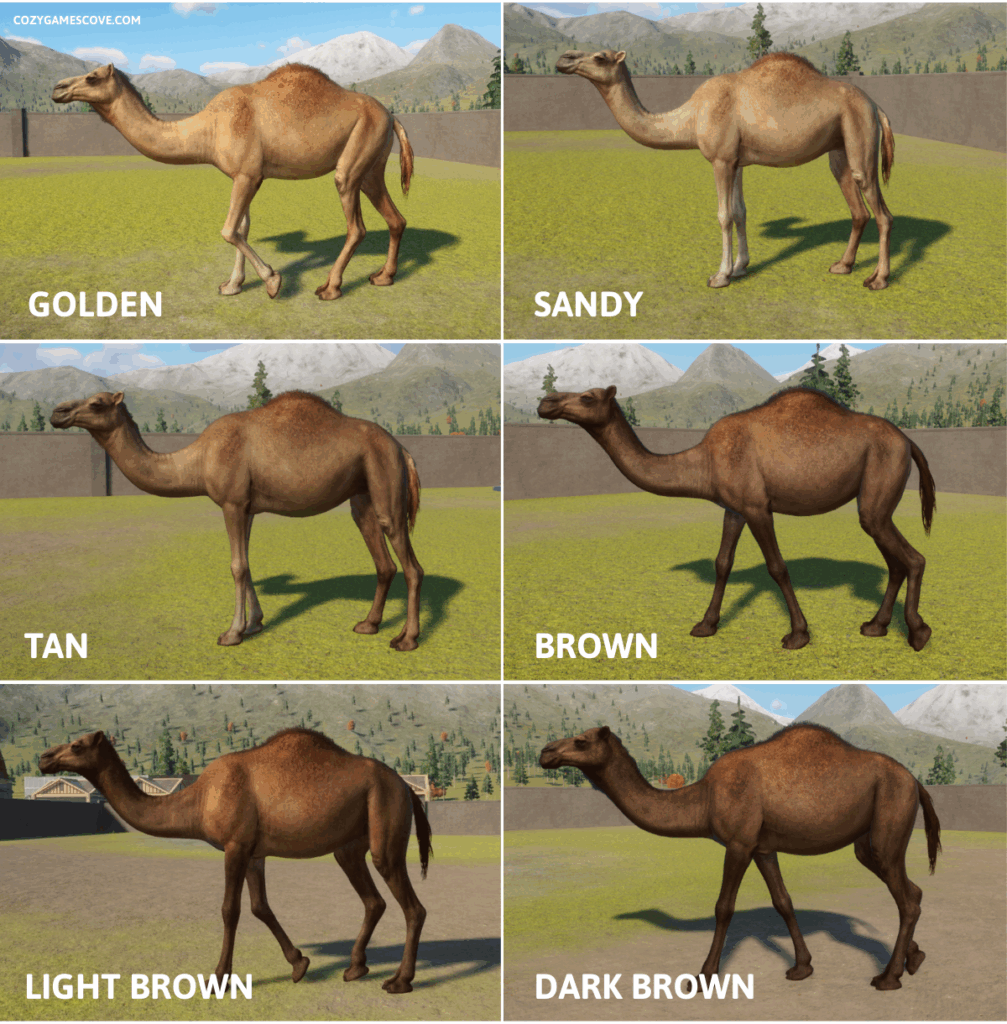
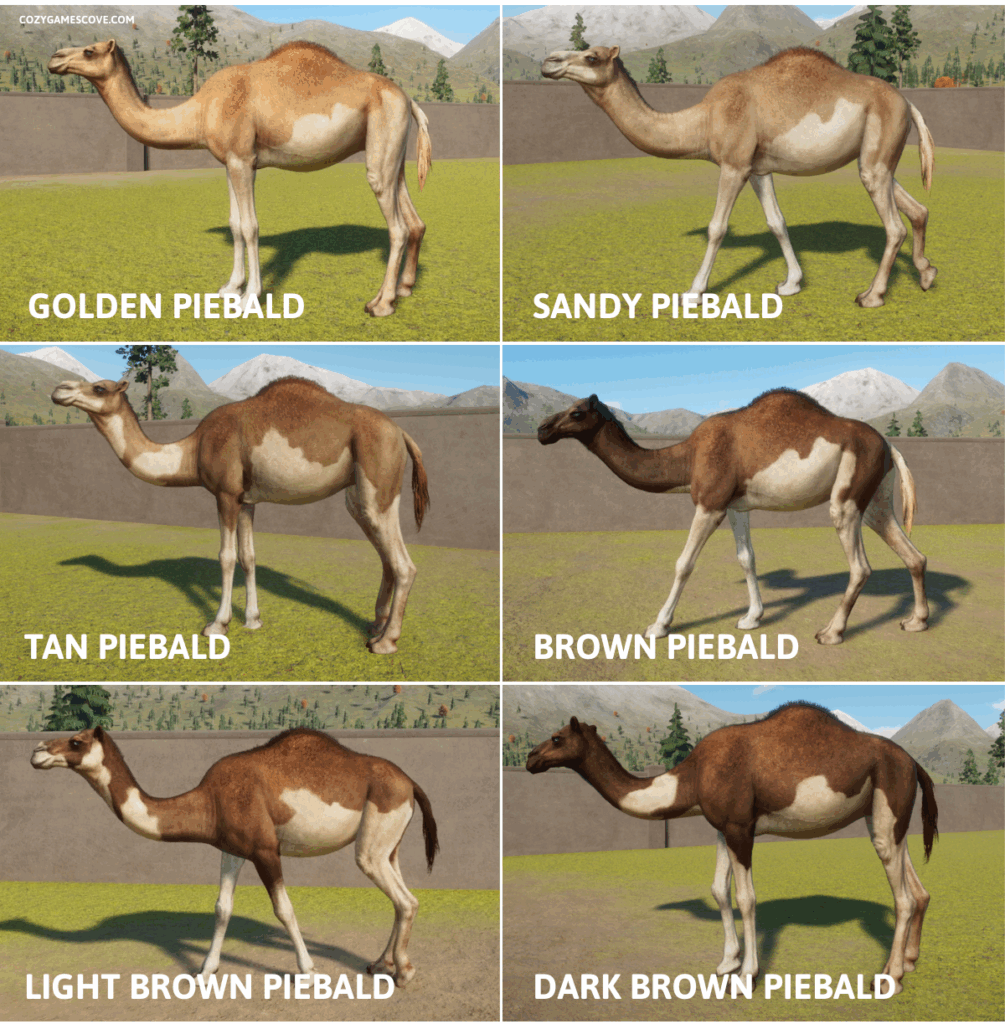
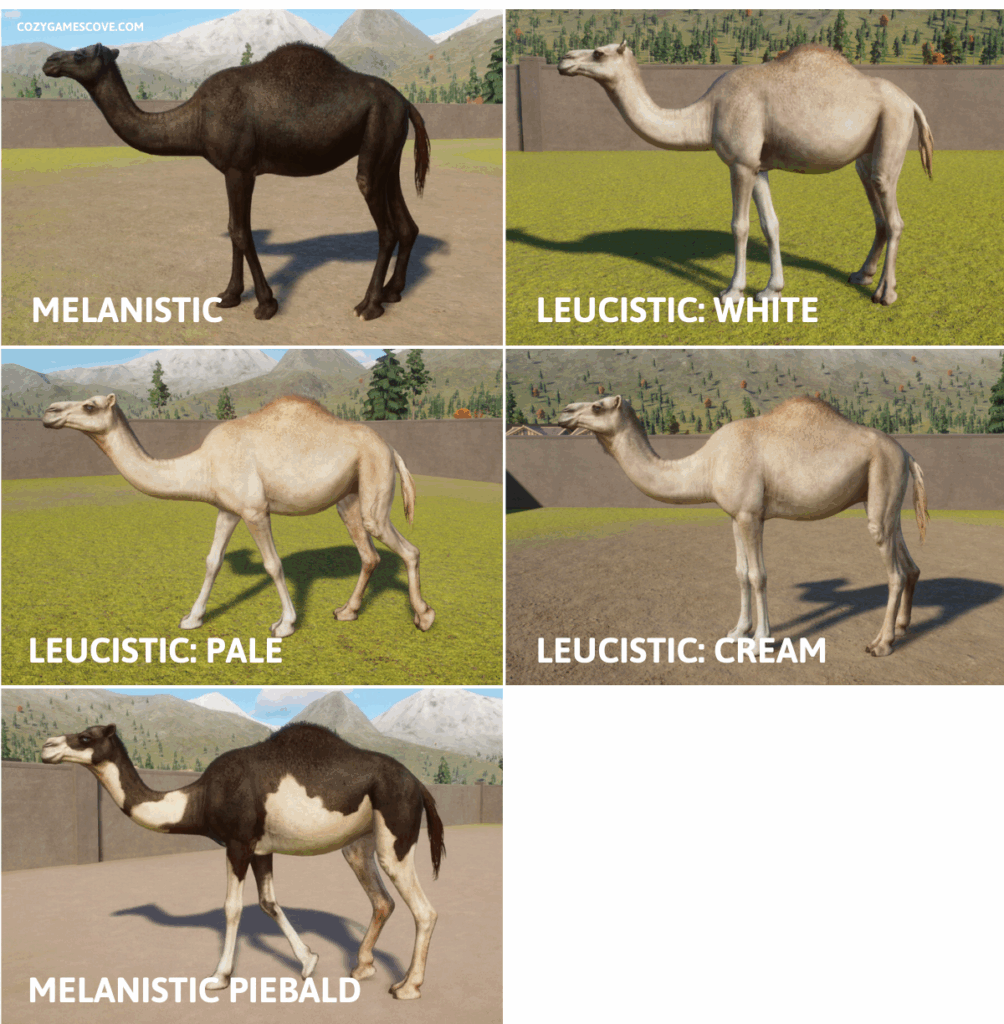
Colours are listed as:
- Golden coat
- Sandy coat
- Tan coat
- Brown coat
- Light brown coat
- Dark brown coat
- Melanistic: Black coat
- Leucistic: White coat
- Leucistic: Pale coat
- Leucistic: Cream coat
- Piebald: Golden and white pied coat
- Piebald: Sandy and white pied coat
- Piebald: Tan and white pied coat
- Brown coat (piebald)
- Light brown coat (piebald)
- Dark brown coat (piebald)
- Melanistic: Black coat (piebald)
Addax
The Addax is a critically endangered antelope found in the Sahara, with fewer than 100 left in the wild.
They survive by eating desert vegetation and get nearly all their water from these plants.
The color of their coats changes from dark grayish-brown in winter to white in summer, which helps them control their body temperature.
In Planet Zoo, Addax can have coats in three different shades of white.
Total colourmorphs: 3
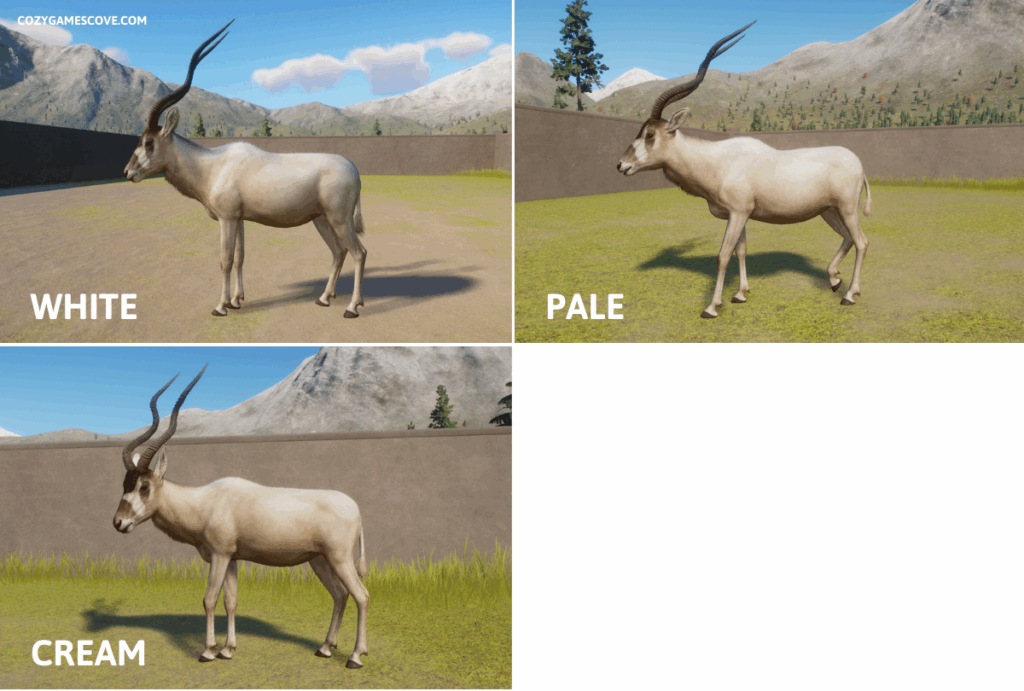
Colours are listed as:
- White coat and brown face
- Pale coat and brown face
- Cream coat and brown face
Dama Gazelle
The dama gazelle is now the rarest gazelle in the world, with fewer than 200 left in the wild. Once found all across the Sahara, they now survive only in two small areas in Chad and Niger.
Dama gazelles have been featured in ancient Egyptian art, as well as in prehistoric rock paintings and engravings. These show that they once lived across a much wider area, including southwest Libya, Egypt’s Western Desert, and the border region between Egypt, Sudan, and Libya.
Dama gazelles are the largest of all gazelle species. They can even stand on their back legs to reach leaves and branches up to six feet off the ground.
In Planet Zoo, the dama gazelle has three blanket colours.
Total colourmorphs: 3
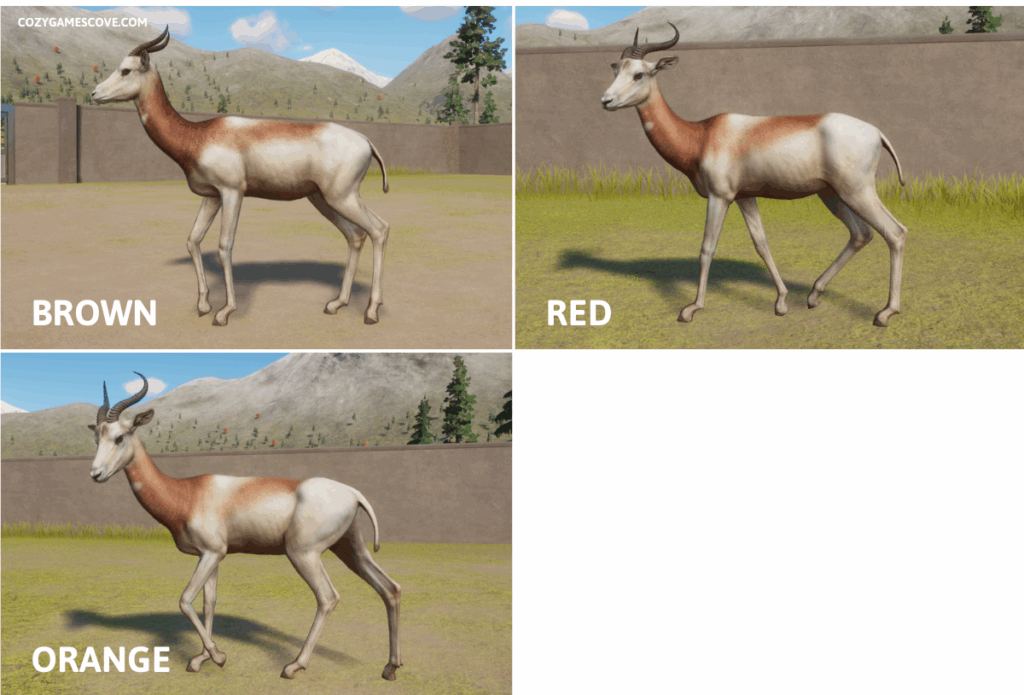
Colours are listed as:
- White coat with brown neck and blanket
- White coat with red neck and blanket
- White coat with orange neck and blanket
African Crested Porcupine
The African crested porcupine holds the title of the largest porcupine species in the world.
These porcupines have sharp quills that can grow over 12 inches long. When threatened, they raise and rattle their quills as a warning. If that fails, they might charge backwards to protect themselves.
African crested porcupines help their ecosystems by spreading seeds and controlling insect populations.
In Planet Zoo, African crested porcupines have black fur and black-and-white striped quills, but there is also a rare leucistic white variety.
Total colourmorphs: 2
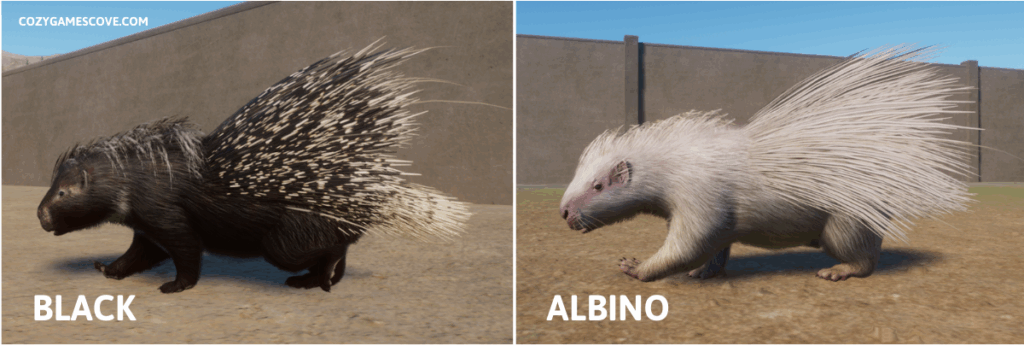
Colours are listed as:
- Black fur and black and white striped quills
- Albino: White fur and quills
Sand Cat
The sand cat is a small wildcat adapted to life in the desert. You can find them in Africa’s Sahara, the Arabian Peninsula, and parts of central Asia. They’re the only cat species that lives only in dry, arid deserts.
They have thick, long hair on the pads of their paws, which protects them against intense heat and cold and helps them navigate shifting sands.
Sand cats have large, low-set ears that let them pick up even the faintest sounds, making it easier to detect prey moving underground.
In Planet Zoo, sand cats come in three shades of brown.
Total colourmorphs: 3
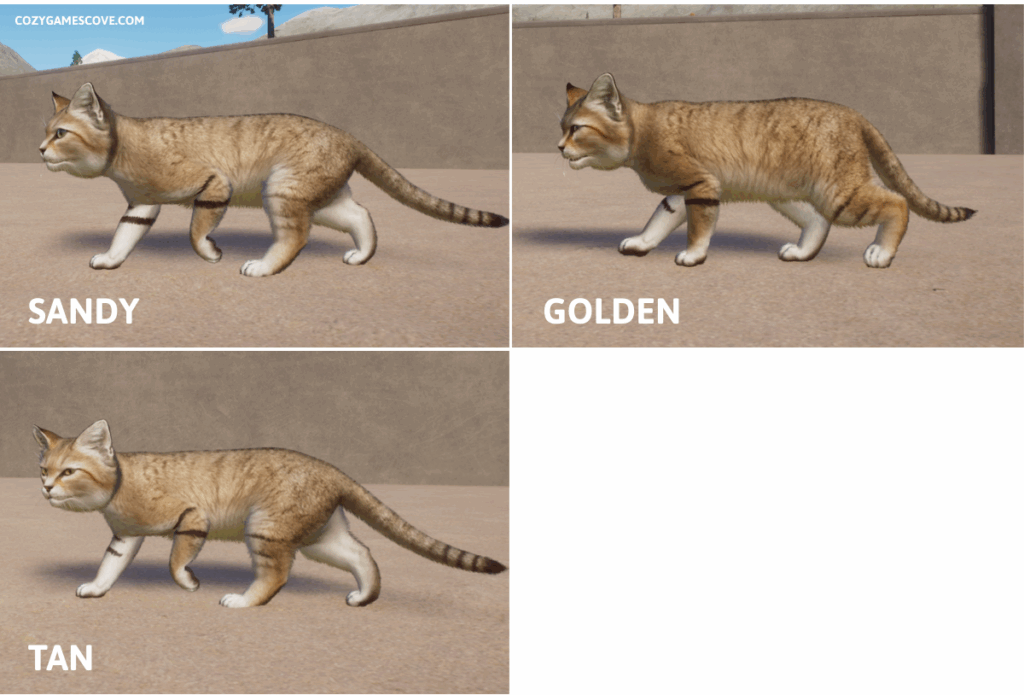
Colours are listed as:
- Sandy fur with dark tabby markings
- Golden fur with dark tabby markings
- Tan fur with dark tabby markings
Black Rhinoceros
Black rhinos can be found across southern and eastern Africa.
These critically endangered animals have a pointed upper lip that helps them pluck leaves and fruit from branches.
A rhino’s horn can grow about three inches each year, and some have reached lengths of up to five feet.
In Planet Zoo, these rhinos come in three different shades of grey.
Total colourmorphs: 3
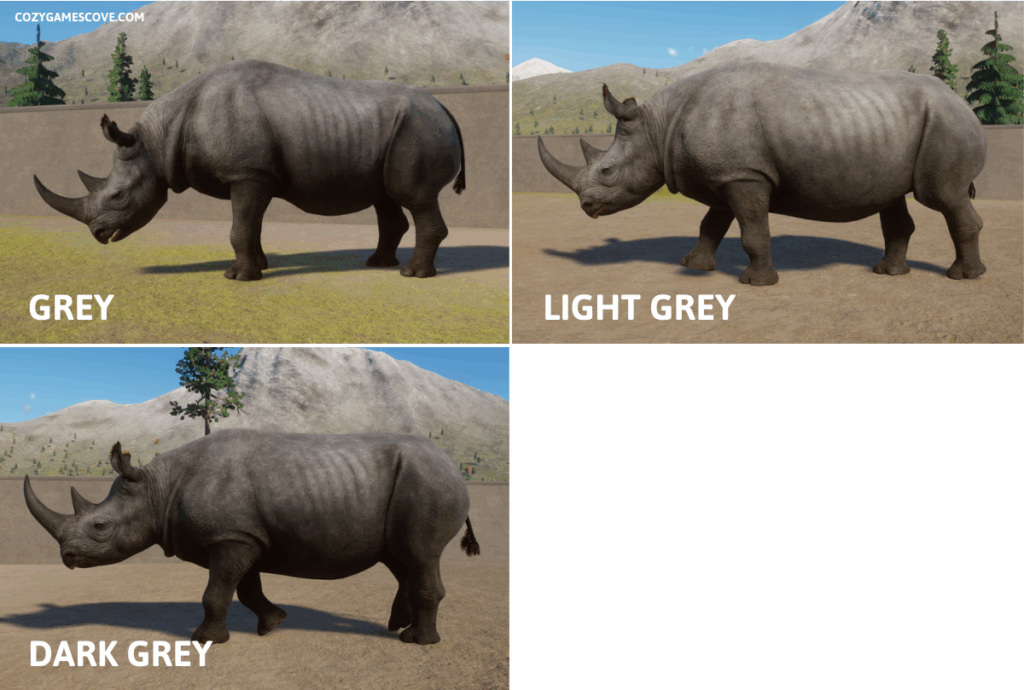
Colours are listed as:
- Grey thick skin
- Light grey thick skin
- Dark grey thick skin
Somali Wild Ass
The Somali wild ass is a subspecies of the African wild ass that lives in the dry regions of the Horn of Africa.
With possibly fewer than 200 adults left in the wild, Somali wild asses are among the rarest equines on the planet.
They are the smallest of all wild equids, and the Somali wild ass has striped legs that resemble those of its zebra relatives.
In Planet Zoo, Somali wild asses come in three different shades of grey.
Total colourmorphs: 3
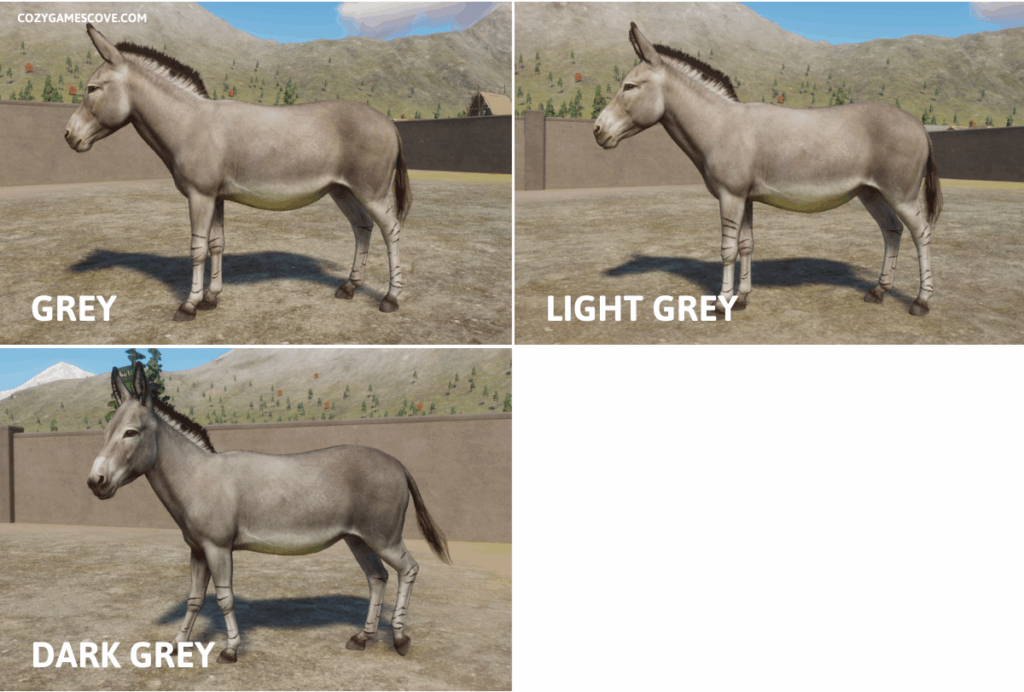
Colours are listed as:
- Grey coat, white legs and black primitive markings
- Light grey coat, white legs and black primitive markings
- Dark grey coat, white legs and black primitive markings
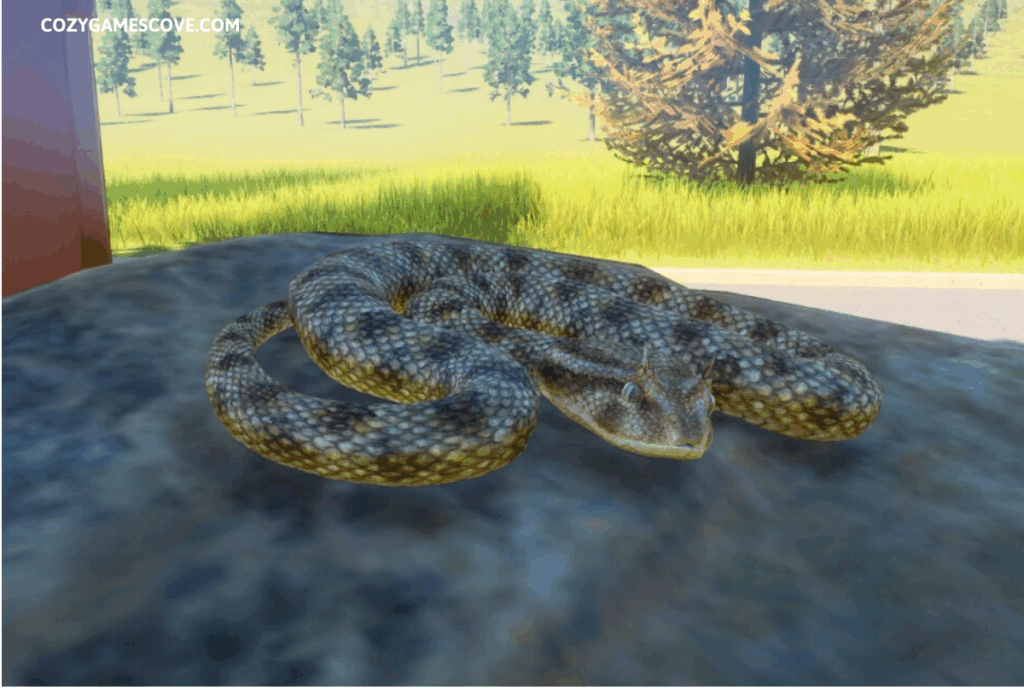
Desert Horned Viper
The desert horned viper is a venomous snake that lives in the deserts of North Africa and the Middle East.
They can bury themselves in the sand, leaving only their eyes and horns visible. This helps them ambush their prey.
In ancient Egypt, these vipers were used to represent the sound “f” in hieroglyphics.
Exhibit animals are not labelled by colour in Planet Zoo, but desert horned vipers have sandy and grey scales.
A List of Every Animal Colour in Planet Zoo
I’ve gathered every animal colour available in Planet Zoo. Below, you’ll find a list of all the colors for each pack!